Working prototype / 01
Something to show.
Three Stories. One developed Session.
A first look at what I’m building.
The inversion · a different way into a group Session
Begin with connection. Let the idea come together.
From an idea to its application
Whether offered as psychoeducation or drawn out in group discussion, an idea can become something participants are then asked to apply to their own lives.
- Introduce or derive an idea
- Understand it together
- Apply it to your life
From someone’s Story to your own language
Kelp starts with individual Stories. Participants notice how they connect, examine their own language, and try something with it. The conceptual and research context helps it fit together at the end.
- Encounter a Story
- Find a connection
- Explore and try your own language
- See how it fits together
Connect with language in real life first. Build toward an understanding of why and how it matters.
The worked Session · 1 of 12
Temporal Discounting
Anchor: Temporal Discounting
Idea: The Future Within Reach
Temporal discounting is the devaluation of an outcome as a function of the delay to its receipt.
The Future Within Reach takes up the delayed outcome’s standing in present choice. The Session develops this Idea through three linguistic Pairings, each linking a Pattern of linguistic variation with an Instrument that operates on it.
The Idea’s three linguistic Pairings
Temporal Reframing + Temporal Anchoring
Pattern — Temporal Anchoring. The degree to which a time reference is fixed to a locatable when rather than left as an unlocated or loosely relative later.
Instrument — Temporal Reframing. Re-expresses a temporal interval through a different reference frame while preserving the interval and the event or outcome located by it.
Both/And + Epistemic Fluidity
Pattern — Epistemic Fluidity. The degree to which a claim permits alternative, coexisting, or revisable interpretations.
Instrument — Both/And. Conjoins opposed predicates under one subject so that both remain present without being forced into resolution.
Future Scene Construction + Granular Specificity
Pattern — Granular Specificity. The resolution at which an experience, event, object, or possibility is rendered into language.
Instrument — Future Scene Construction. Constructs a possible future as a situated episode by giving it particular temporal, participant, action, environmental, or sensory structure.
These Pairings structure the Stories below. Participants encounter their linguistic realizations in the Clips before the underlying Patterns, Instruments, and research context are introduced.
Temporal Discounting · participants start here
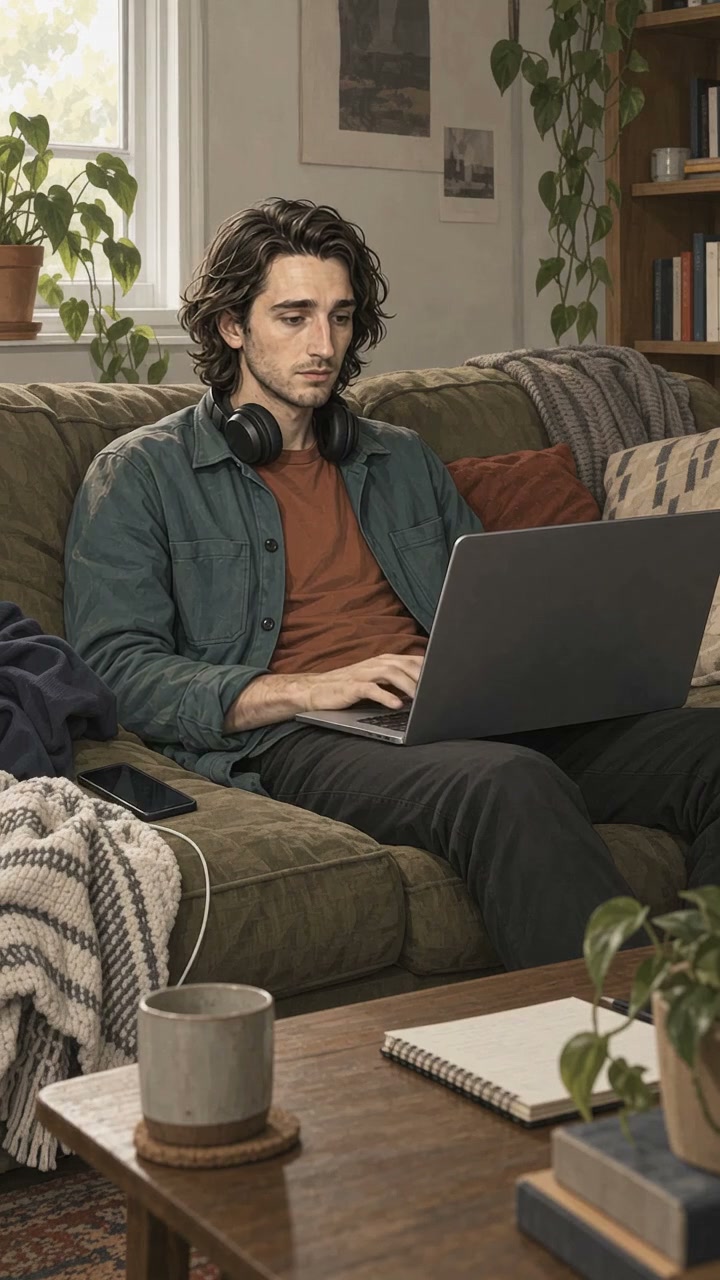
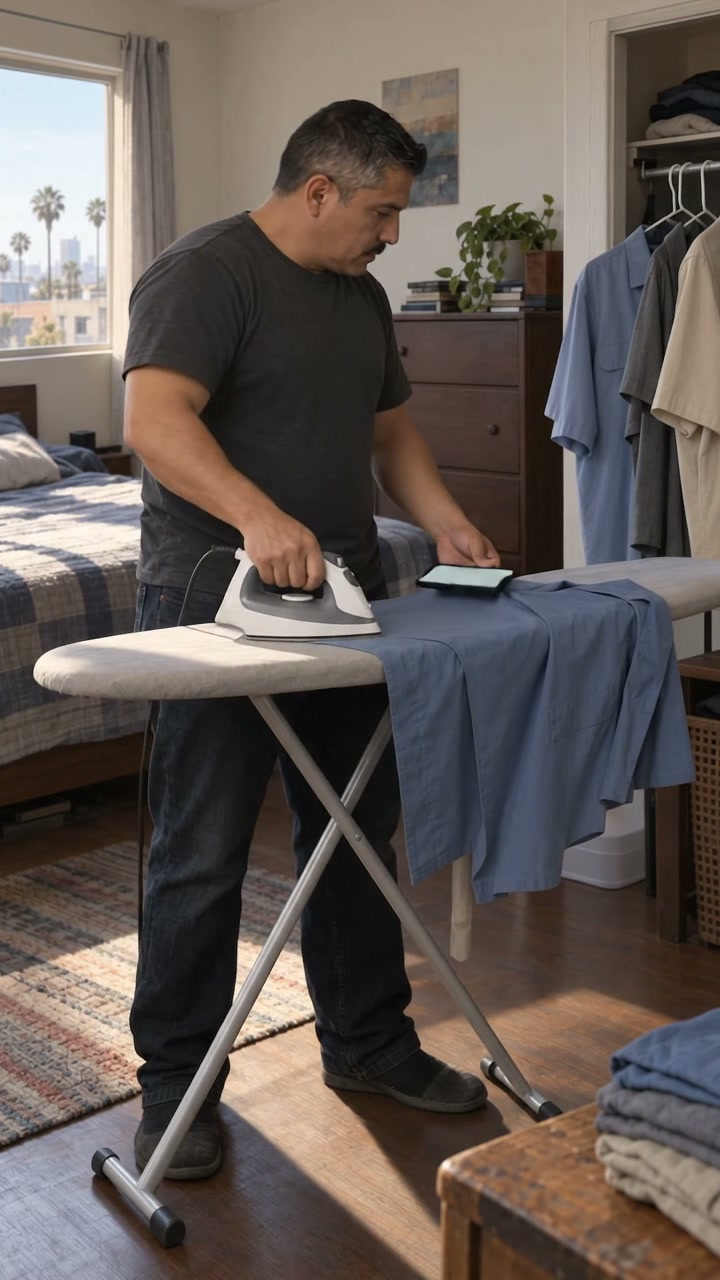
Three people. Three Stories.
Story Underneath Watch
Working media: Stephen’s expanded C05 accepted at 80/20. Rafa and Denise are first-pass review Clips.
Story Cards & the Translation Surface
Watch the Clips. Place what connects.
Watching, listening, and sorting happen together.
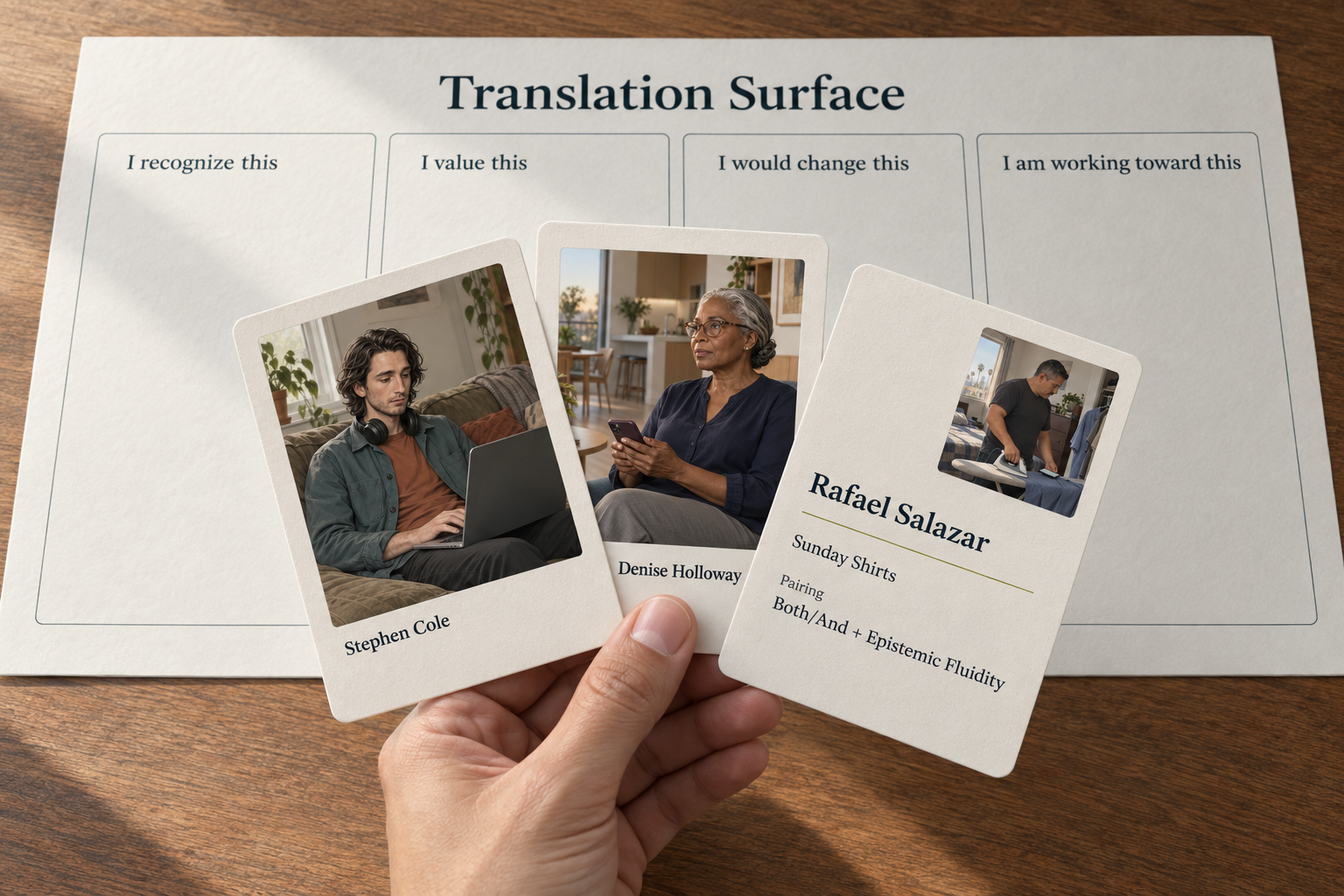
A physical response, without writing.
Participants watch and listen to the short-form Clips while sorting the corresponding cards. The encounter has the familiarity of social media content, with a physical action available as something connects: hold the card, consider the connection, and place it on the Translation Surface.
A placement may express recognition, something valued, something to change, or something to work toward. Participants can begin responding before they have composed an explanation.
This is designed as a low-threshold form of active engagement: a physical analogue to pausing on a feed item. The placement makes a response available to return to and explore; it does not measure attention or assign a score. Cards can be moved, reconsidered, or left unplaced.
The Story image identifies the lived fragment. The Pairing on the reverse connects it to the linguistic architecture for the later conceptual discussion.
Facilitated processing · from placement to language
Generate meaning from what you placed.
Participants develop their own semantic content from their responses to the Stories.
Participants explore what a placement means to them: what they recognized, how it connects with their experience, and the language they use to describe that connection. The facilitator reads the energy in the room, people’s readiness to talk, and the card arrangements to choose a format that helps this material develop. The format can change as the conversation unfolds.
Five available formats, chosen to suit the room.
Individual work
Reflect on your placements and the language behind them.
Neighbor dyads
Talk with the person next to you, whatever cards you each placed.
Connected dyads
Explore a connection or contrast in your card placements with another participant.
Small groups
Gather around patterns in the cards and discuss what those placements mean to each of you.
Whole-group discussion
Explore the responses together—particularly when five or six people are in the room.
Supported by a facilitator’s guide. The guide supports the facilitator’s judgment about how to develop what participants have expressed through the cards. The room determines which format is useful.
Carried into the Lab. This work develops the participant-generated material for the workbook exercises that follow, undertaken individually or, where useful, in pairs.
Kelp Session Workbook
Making New Meaning
Design intention · workbook and exercises in development.
The Clips and cards have invited attention and connection. Reflection and conversation have given those responses language. The workbook is where participants capture that material and work with it in writing, individually or in pairs.
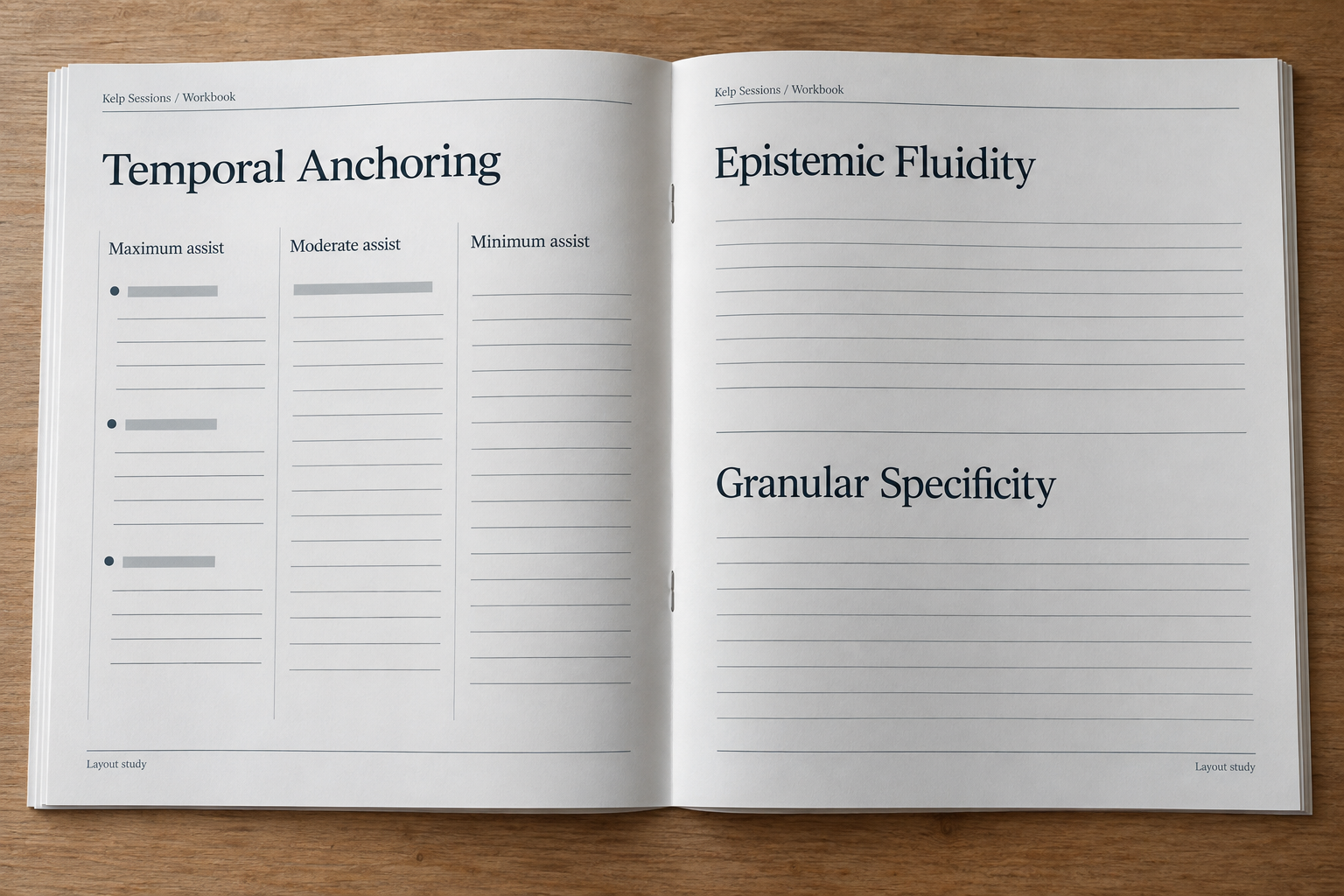
Organized by linguistic Pairing
Pattern + Instrument
The workbook is organized around the Pairings shared across the Stories, rather than separate chapters for Stephen, Rafa, and Denise.
- Temporal AnchoringTemporal Reframing
- Epistemic FluidityBoth/And
- Granular SpecificityFuture Scene Construction
Each row: Pattern / Instrument
Assistance chosen for that day
Three ways into the writing.
Maximum, moderate, and minimum assistance are available according to how a person finds themselves after the Clips, sorting, and conversation. The choice belongs to that moment; it carries no judgment about education or linguistic capacity.
Each route leads to writing with material participants have already begun to generate.
Leave with the whole workbook.
Even if someone works with only one Pattern and one Instrument during the Session, the entire workbook goes home with them. Familiar Story images offer a way back into the work whenever they want to return. The workbook will also include the Research Dossier.
Now, what sits underneath
The Future Within Reach.
The Idea behind the Temporal Discounting Session.
Something can matter later and still struggle to have a place in now.
How I build it
- Research + linguistic architecture
- Idea
- Scenario
- People / Stories
- Clips + cards
- Lab + Research Dossier
How a participant encounters it
- Lived fragments
- Recognition
- Sorting
- Conversation
- Experimentation
- Concept + research context
One branch in a much larger system
Follow the idea upstream.
Open Psychological, then Cognitive, then Decision Processes.
A partial view of the framework. Neighboring branches are shown, but not expanded here.
Inside the room
Encounter. Hold. Move. Try.
Meaning begins before the explanation.
- 01
Stories / Clips
Encounter a lived moment.
- 02
Story Cards
Recognize something alongside someone else.
- 03
Translation Surface
Place it. Move it. Leave it undecided.
- 04
Facilitated processing
Reflect privately or talk together.
- 05
Lab Exercises
Try language with meaning already generated.
- 06
Research Dossier
Return to the research as context.
Recognition and alongsideness.
No scoring. No diagnosis.
The Lab begins with the participant’s own meaning.
Research arrives afterward, as context rather than verdict.
An idea drawn from an architecture becomes something a person can encounter, hold, move, discuss, and try. Then the Research Dossier returns to the research—after meaning has already begun.
Fall 2026 · the working set
Twelve Sessions.
One worked prototype. Eleven provisional candidates for development.
The same plan, with the rest revealed
From a prototype to real rooms.
Longer-horizon ambitions; no existing Apple relationship or integration.
This is where I’m headed.